
The New Value Chain After Systemic Disturbances
The Architecture Built During the Shock
For years, globalization was explained through the language of efficiency. Lean inventories, optimized logistics, just-in-time manufacturing, ultra-specialized regions, and hyper-integrated trade corridors became the dominant operational religion of modern economies. The system appeared elegant because it removed friction. Production moved where labor was cheaper, components crossed continents with precision timing, and entire industries became dependent on invisible synchronization layers that few outside supply chain management truly understood. What the disturbances of the past years revealed, however, was that the architecture had become so optimized for efficiency that it had quietly removed resilience from its own foundation. The public conversation focused on spectacle, wether geopolitical theater, sanctions, ideological polarization, inflation panic, culture wars, and endless commentary cycles , while underneath, something far more important was taking place. The global value chain was reorganizing itself under pressure.
The semiconductor industry became perhaps the clearest demonstration of this transformation. Public discourse simplified the situation into phrases such as “chip shortage” or “technology war,” but the deeper reality exposed an extraordinary concentration of strategic dependency. Advanced semiconductor manufacturing relied heavily on Taiwan Semiconductor Manufacturing Company in Taiwan, creating a vulnerability with implications extending far beyond consumer electronics. Governments rapidly understood that semiconductors were not merely commercial products but civilizational infrastructure underpinning defense systems, artificial intelligence, cloud computing, automotive production, telecommunications, and industrial automation. The response was structural rather than rhetorical. The United States launched the CHIPS and Science Act, the European Union accelerated the European Chips Act, while Japan and South Korea reinforced strategic industrial partnerships and domestic manufacturing incentives. Production diversification expanded into Arizona, Germany, and Japan, not because globalization had ended, but because the geography of trust had changed. The system moved away from singular concentration toward distributed resilience.
TSMC
European Chips Act
U.S. CHIPS Act
Energy systems underwent a similar recalibration. Before 2022, much of Europe operated under assumptions of stable and predictable Russian pipeline gas flows. Public discussion centered on sanctions, diplomacy, and political positioning, yet the real transformation unfolded in infrastructure and logistics. Liquefied natural gas terminals expanded rapidly across Europe. Floating regasification facilities appeared at unprecedented speed. Norway increased exports, while suppliers such as Qatar and the United States became increasingly central to European energy security calculations. Germany, long optimized around industrial efficiency and relatively stable energy assumptions, suddenly had to redesign parts of its strategic economic architecture under active pressure. The result was adaptation that from some angles looked like paralysis. Energy routing diversified, storage policies accelerated, and renewable deployment gained urgency not only for environmental reasons but for strategic continuity. The disturbance exposed that modern economies are not governed solely by markets but by the physical reliability of corridors, pipelines, terminals, cables, and reserves.
International Energy Agency
European Commission Energy Platform
Shipping and logistics networks offered another revealing example. Disruptions in the Red Sea transformed maritime routing from a technical operational matter into a geopolitical concern visible to the broader public. Cargo did not stop moving, but shipping companies rerouted vessels around the Cape of Good Hope, increasing transit times, fuel costs, insurance exposure, and inventory pressure. The significance of the event was not simply the disruption itself, but what it revealed about the adaptive nature of modern trade systems. Ports, insurers, shipping alliances, and freight operators increasingly functioned as geopolitical actors rather than passive commercial intermediaries.
The Strait of Hormuz offers perhaps the most concentrated example of why modern economies have returned to thinking in terms of resilience rather than efficiency alone. Roughly one-fifth of globally traded oil and a significant share of liquefied natural gas pass through this narrow maritime corridor connecting the Persian Gulf to international markets. Whenever tensions rise in the region, financial markets immediately react, not because supply has necessarily been interrupted, but because the possibility of disruption exposes how dependent global energy systems remain on a small number of critical passages. The importance of Hormuz is therefore not limited to energy prices. It serves as a reminder that economic architecture ultimately rests on physical geography. Pipelines, ports, shipping lanes, undersea cables, and strategic straits continue to shape the functioning of the global economy regardless of how digital modern commerce may appear. In response, governments and companies increasingly invest in alternative routes, diversified suppliers, strategic reserves, and energy redundancy. The objective is not to eliminate risk entirely, but to prevent any single corridor from becoming a point of systemic failure. Much like semiconductors, logistics networks, or natural gas infrastructure, the lesson of Hormuz is that resilience begins where concentration ends.
Companies began reassessing inventory strategies and transportation exposure, acknowledging that uninterrupted speed could no longer be treated as the primary organizing principle of global commerce. The old architecture optimized for minimal friction. The emerging architecture optimizes for survivability under friction.
World Trade Organization
UNCTAD Trade and Development
Perhaps one of the most misunderstood developments has been the so-called “China+1” strategy. Public rhetoric often framed the situation as a complete decoupling from China, yet official trade flows and corporate behavior show something more nuanced. China did not disappear from global manufacturing. Instead, companies began reducing single-point dependency by expanding production into Vietnam, India, Mexico, Indonesia, and Thailand. Apple expanded assembly operations in India and Vietnam while maintaining substantial Chinese production capacity. Automotive suppliers, electronics manufacturers, and industrial producers increasingly adopted layered manufacturing strategies distributed across multiple jurisdictions. The logic was not ideological isolation but operational redundancy. In practice, globalization became more complex rather than smaller. Diversification replaced concentration as the preferred form of resilience.
Apple Supplier Responsibility Report
OECD Supply Chain Resilience Review
The automotive sector demonstrated how fragile ultra-optimized systems had become. For decades, “just-in-time” manufacturing represented the gold standard of industrial efficiency. Minimal inventories reduced costs and maximized operational precision. Yet semiconductor shortages revealed that entire production lines worth billions of euros could stop because of missing low-cost components. The consequences forced a philosophical shift in industrial management itself. Strategic inventories increased, supplier diversification accelerated, regional sourcing gained importance, and vertical integration returned in selected sectors. Supply continuity was no longer treated as a procurement problem but as a board-level strategic concern. The disturbances exposed that efficiency without redundancy creates systems that are economically elegant but structurally brittle.
Critical minerals and rare earth supply chains further reinforced this transformation. Advanced economies discovered that the infrastructure of the digital and green transition depended heavily on concentrated extraction and processing capacities located in limited jurisdictions. Lithium, cobalt, nickel, and rare earth elements became strategic assets rather than obscure industrial commodities. Governments responded through mining diplomacy, strategic partnerships, battery alliances, and industrial subsidies. The narrative of a purely digital future collided with the physical reality that all advanced systems ultimately depend on mines, ports, energy corridors, industrial processing, and shipping routes. Beneath the language of innovation remained the enduring architecture of material civilization.
Food and agricultural systems revealed similar vulnerabilities. Fertilizer shortages, grain corridor disruptions, and transport instability transformed food supply chains from commercial concerns into national security priorities. States intervened directly to stabilize strategic agricultural flows while reassessing storage capacity, domestic production resilience, and transport dependencies. The disturbances demonstrated that modern societies cannot rely exclusively on market efficiency for foundational needs. Continuity itself became strategic infrastructure.
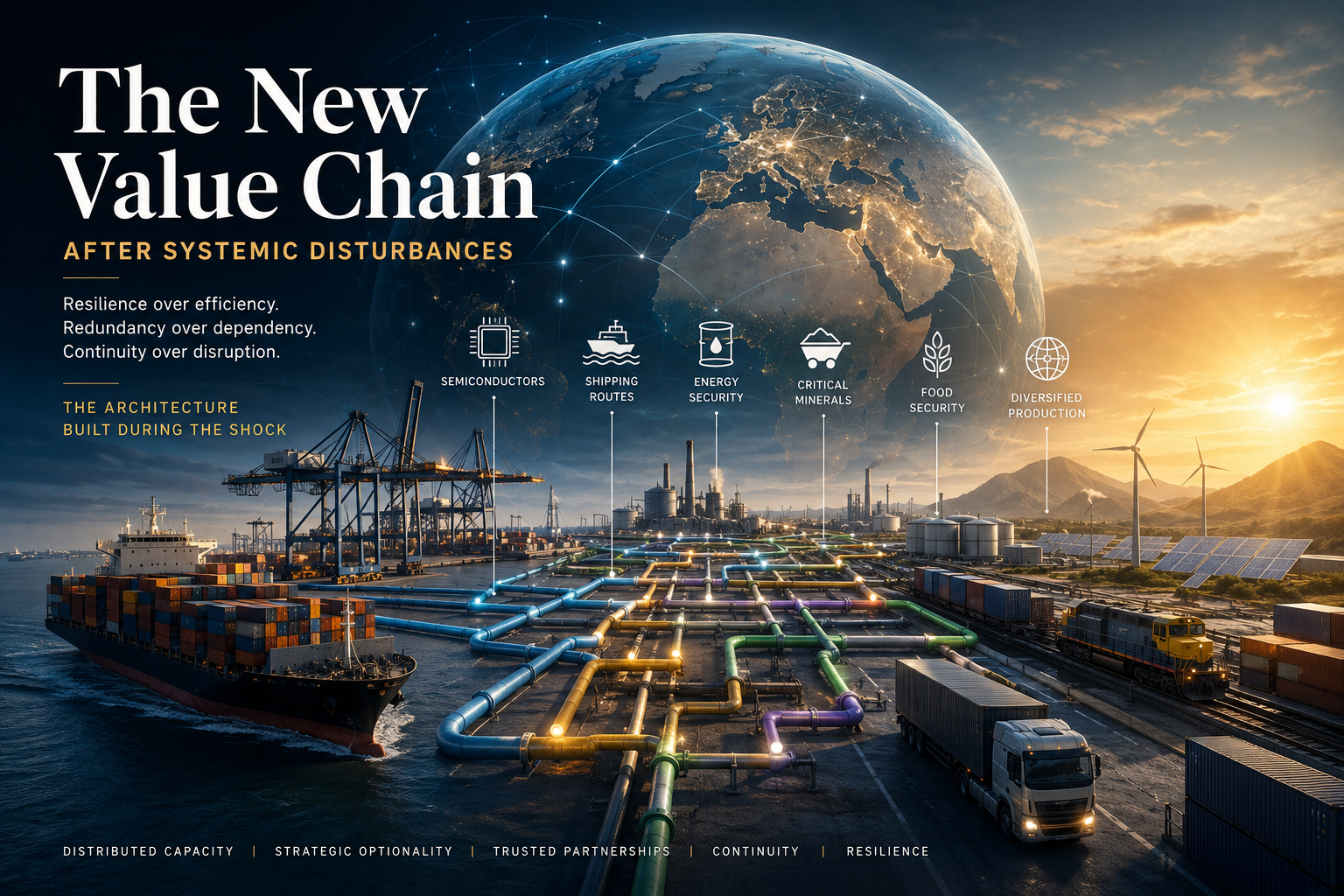
The most important transformation, however, may not be just geographic or industrial, but also philosophical. The governing logic of the global economy quietly changed during the disturbances. Pre-disturbance systems prioritized maximum efficiency, low inventory exposure, rapid delivery, and aggressive optimization. Post-disturbance systems increasingly prioritize resilience, optionality, redundancy, continuity, and strategic autonomy. We are not acknowledging deglobalization, but a form redesign of globalization under conditions of systemic stress.
While public discourse remained captivated by noise, outrage, and ideological theatre, the real work occurred underneath: manufacturing diversified, inventories expanded, logistics rerouted, strategic sectors hardened, governments reentered industrial policy, and the geography of trust was rewritten in real time. The disturbances did not destroy the global value chain. They revealed where efficiency had become dependency, where optimization had eliminated resilience, and where economic architecture had confused speed with stability.
The new value chain was built during the shock.