
Norway, the World Cup and the Invisible Rise of Nordic Capital.
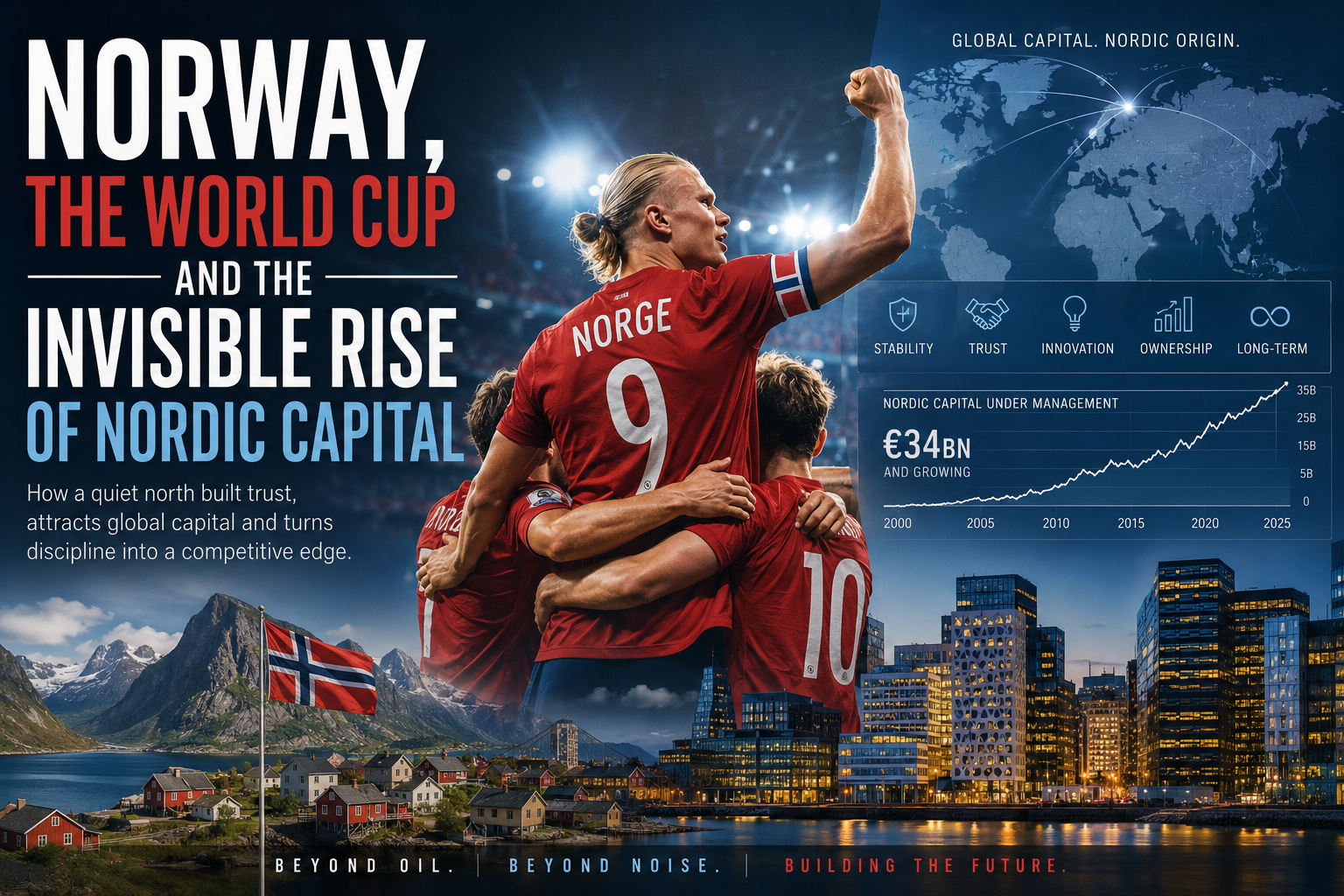
Norway’s World Cup performance may be the visible event, but behind the sporting confidence sits a much larger Nordic story: a region that has learned how to transform stability, specialist knowledge and institutional credibility into internationally scalable capital. That transformation is not represented only by Norway’s sovereign wealth fund or by Stockholm’s technology companies. It can also be observed through firms such as Nordic Capital, whose expansion reveals how Northern Europe moved from being perceived as a small, peripheral market into becoming an influential centre of ownership, company-building and strategic capital allocation.
Nordic Capital was established in 1989, at a time when the Nordic economies were still viewed primarily through traditional industries, national champions and relatively contained domestic financial systems. By late 2025 and early 2026, the firm reported approximately EUR 34 billion in assets under management and around EUR 30 billion invested in more than 150 middle-market companies across Northern Europe and North America. The scale matters, but the underlying pattern matters more. Nordic Capital did not grow by trying to participate in every sector or by imitating the broadest global investment houses. It built its position through repeated specialization in healthcare, technology and payments, financial services, and services and industrial technology, sectors where regulation, operational knowledge, digital infrastructure and long-term demand create substantial barriers to entry.
This is one of the defining characteristics of contemporary Nordic capital. It does not depend exclusively on geographical size. The Nordic domestic markets are relatively small, which forces ambitious companies and investors to think internationally at an early stage. Products must travel, management systems must scale and technology must operate across jurisdictions. Companies cannot rely indefinitely on a vast protected home market, so internationalization becomes part of their design rather than a later-stage ambition. Nordic Capital’s own investment geography now spans Northern Europe and North America, reflecting a model in which regional expertise serves as the starting point for global expansion rather than the boundary of activity.
Its fundraising history also demonstrates the growing international confidence in this model. Nordic Capital’s ninth flagship fund closed at EUR 4.3 billion in 2018. Fund X reached EUR 6.1 billion in 2020, raised entirely during the pandemic in less than six months and without physical investor meetings. Fund XI then closed at EUR 9 billion in 2022, exceeding its EUR 8 billion target and becoming more than 45 percent larger than its predecessor. That progression, from EUR 4.3 billion to EUR 6.1 billion and then EUR 9 billion within four years, was not simply a rise in available money. It represented the increasing willingness of global institutional investors to entrust substantial capital to a Northern European investment platform during periods of economic disruption and difficult fundraising conditions.
The same signal appeared in the mid-market strategy. Nordic Capital’s first Evolution fund raised EUR 1.2 billion in 2021. Evolution II closed at its EUR 2 billion hard cap in December 2024, only four months after launch, exceeding its EUR 1.4 billion target and becoming 65 percent larger than its predecessor. The fund reported a re-up rate above 100 percent by capital, meaning that returning investors collectively committed more than they had to the earlier fund. Its investor base was also strikingly international: 41 percent of commitments came from Europe, 35 percent from the Americas, 21 percent from Asia and 3 percent from the Middle East. Pension funds accounted for approximately 41 percent of the capital, asset managers and advisers 26 percent, sovereign wealth funds 14 percent, family offices and foundations 13 percent, and financial institutions 6 percent.
Those figures complicate the conventional image of Nordic economic power. This is not merely Nordic money investing in Nordic companies. It is global institutional money entering a Nordic-managed system because investors believe that the region’s governance culture, sector expertise and operational methods can produce durable returns. Nordic Capital functions as an intermediary between international pools of savings and a Northern European company-building model. American pension money, Asian institutional capital, sovereign wealth and European savings are gathered into funds and then deployed through a framework developed in the Nordic business environment. The region is therefore not only exporting products or technology. It is exporting methods of ownership.
That method is especially visible in the firm’s preference for structurally growing, relatively non-cyclical industries. Healthcare, financial infrastructure, payments, regulatory technology and industrial services may not generate the same spectacle as consumer brands or social-media platforms, but they occupy essential positions inside modern economies. They process transactions, commercialize medicines, manage regulatory reporting, finance smaller enterprises, organize healthcare procurement and provide the digital rails through which other businesses operate. Nordic Capital’s portfolio includes companies such as One Inc, whose network processes more than USD 70 billion in annual insurance payments for over 240 carriers, and IntegriChain, which provides technology, data and consulting services for pharmaceutical commercialization and market access. It has also invested in businesses such as Vivecti Group, whose technology-enabled procurement network consolidates more than EUR 3.3 billion in purchasing volume for healthcare providers and suppliers.
These are pieces of economic infrastructure, not just peripheral assets. Their importance lies precisely in the fact that most consumers never notice them. A payment platform embedded in insurance, a regulatory reporting system, a pharmaceutical market-access network or a healthcare procurement platform rarely becomes a cultural symbol. Yet such companies determine how quickly money moves, how regulation is implemented, how medicines reach markets and how institutions manage complexity. The invisible Nordic economy is being built inside these operational layers.
This is where the comparison with football becomes more interesting. Norway’s progress at the World Cup appears sudden only when the preparation remains unseen. The same is true of capital. A result becomes visible on the scoreboard, but the capability is built earlier through recruitment, systems, training, data, institutional continuity and the willingness to invest before public attention arrives. Nordic Capital describes its own model in terms of partnership with founders and management teams, deep sector knowledge, operational expertise and international expansion. In the Evolution I portfolio, 70 percent of investments had been made in collaboration with founders, while 80 percent were completed outside broad auctions. That suggests a model based not only on bidding more aggressively for publicly marketed assets, but on relationships, credibility and proprietary access to companies whose owners believe that the investor can help them scale.
It is very important that the partnership language should not be romanticized. Private equity remains a demanding ownership model, with expectations regarding growth, performance and eventual realization of value. But Nordic Capital’s rise shows that financial influence can be constructed through something more sophisticated than the simple accumulation of assets. Capital gains authority when it is combined with the ability to identify a sector, understand its operational constraints, professionalize a company, support acquisitions, enter new markets and create a credible route from regional strength to international scale.
The sustainability dimension follows the same institutional logic. Nordic Capital reported that 95 percent of its assets under management were classified under Article 8 of the European Union’s Sustainable Finance Disclosure Regulation in its 2025 transparency reporting. The classification does not automatically prove environmental or social impact, but it does demonstrate how deeply sustainability criteria have entered the architecture of European capital allocation. Environmental targets, governance standards and reporting systems are no longer treated only as external reputation exercises. They increasingly influence fundraising, risk management, operational planning and the relationship between investment managers and their institutional investors.
This is why the phrase Nordic capital should be understood as more than a reference to money originating in Scandinavia. It describes a system in which trust lowers transaction costs, specialization improves investment judgment, public institutions produce stability, private capital professionalizes companies and international investors accept Northern European governance as a credible framework for deploying global savings. The strength is not located in one spectacular corporation or one billionaire founder. It is distributed across pension institutions, sovereign funds, private-equity firms, industrial companies, technology platforms, universities, regulators and management cultures.
Norway occupies a special place in this landscape because it combines energy wealth, sovereign ownership and unusually high institutional capacity. But the larger Nordic economic system extends through Stockholm, Copenhagen, Helsinki and Oslo, and increasingly into London, Frankfurt, New York and other global financial centres. Nordic Capital itself has expanded across this geography, illustrating how the region’s capital is no longer confined to the North. It now participates directly in the restructuring of healthcare, payments, financial services and industrial technology across Europe and North America.
The World Cup gives the public a flag, a team and a score. But in the background, capital offers no such simple image. Its victories appear as a fund closing above target, a founder choosing a strategic partner, a Nordic platform entering the American market, a healthcare company expanding internationally or a payment network becoming embedded in an entire industry. These events rarely produce fireworks in Oslo. Yet they reveal the same underlying confidence: the belief that a small country or region does not need to dominate the noise in order to influence the system.
The rising Nordic economy was not entirely ignored. It was simply observed through the wrong categories. The world continued to see oil, salmon, furniture, welfare states and cold-weather competence, while the region was building investment platforms, digital financial infrastructure, globally scalable healthcare companies and a sophisticated architecture for converting trust into ownership.
Norway’s World Cup run may be the cultural moment that makes the pattern visible. The team is not appearing from an economic vacuum. It represents a society from a region that has spent decades turning discipline into capability and capability into international reach.
The football made the headline. The capital system wrote the story.