
The last supper dress code
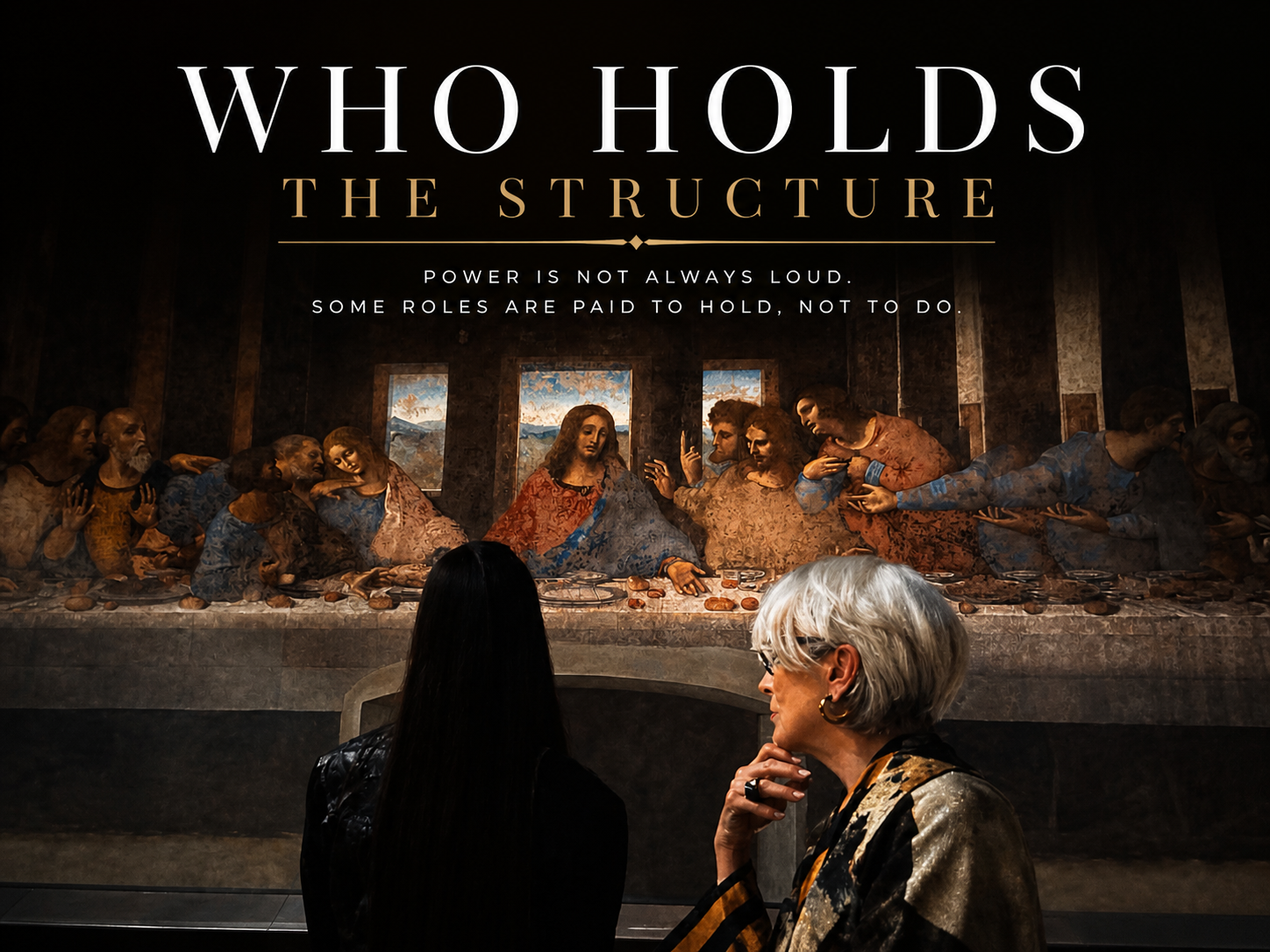
What distinguishes The Devil Wears Prada in its second iteration is not its continuation of character arcs or its surface engagement with fashion, but its ability to shift from narrative to structure, from personality to jurisdiction, constructing a film that no longer explains power but simply places it in space and allows it to be read.
The film abandons the didactic tone of its predecessor, where ambition, sacrifice, and identity were articulated through dialogue and conflict, and instead operates through composition, pacing, and repetition, aligning itself more closely with the logic of classical works such as The Last Supper by Leonardo da Vinci, where meaning is not stated but constructed through placement, proportion, and relational tension. This is not an aesthetic coincidence but a deliberate elevation of the film’s internal grammar, moving from storytelling to what can only be described as architectural cinema, where each frame holds a function within a larger system of meaning.
At the center of this system lies a refined understanding of authority, one that rejects the contemporary obsession with visibility, expression, and emotional transparency, and instead returns to a more disciplined model in which power is exercised through restraint, timing, and boundary; characters are no longer defined by what they say or even what they do, but by what they allow, what they refuse, and how they position themselves within structures that exceed them. In this sense, the film does not portray leaders as individuals who act, but as figures who hold conditions, preserving coherence in environments that would otherwise fragment under pressure.
The recurring visual echo of the long table, the controlled interiors, and the strategic use of silence constructs a spatial hierarchy that mirrors institutional environments, from editorial rooms to boardrooms, suggesting that the logic of fashion is not an isolated cultural phenomenon but a microcosm of larger systems of governance and control; here, fashion is stripped of its superficial reading and revealed as a discipline of continuity, where variation is permitted only within the boundaries of a stable, non-negotiable core. This is where the film aligns itself with global brands such as Coca-Cola or Starbucks, not in content but in operational philosophy: consistency is not repetition for its own sake, but a mechanism for maintaining identity across time and space.
What the film understands, and what it communicates without exposition, is that systems do not fail because individuals are flawed, but because the structures designed to absorb those flaws are either weak, unclear, or compromised; this insight is embedded in its quieter moments, where gestures replace speeches and positioning replaces confrontation, allowing the viewer to perceive not the drama of decision, but the conditions that make decision possible. It is a rare move in contemporary cinema, which often confuses intensity with depth, to instead present a world in which tension is contained rather than performed, and where the absence of visible conflict signals not emptiness, but control.
There is, however, a subtle risk in this approach, one that the film navigates but does not entirely resolve, and that is the potential for misinterpretation by audiences conditioned to read visibility as meaning; in stripping away overt narrative cues, the film demands a level of attention and structural literacy that may not be widely distributed, leading some viewers to perceive it as distant, cold, or overly stylized. Yet this distance is not a flaw but a condition of its precision, because proximity would reintroduce the very noise the film seeks to eliminate.
In its final movement, the film makes its most decisive statement not through climax but through withdrawal, positioning its central figure outside the table, outside the immediate system of exchange, suggesting that true authority does not reside in constant participation but in the ability to step beyond the structure while still defining it. This is not an act of escape, but of jurisdiction, marking the difference between those who operate within systems and those who maintain them.
The Devil Wears Prada II ultimately succeeds not because it entertains, but because it re-establishes a language of power that has been largely diluted in contemporary culture, reminding the viewer that not all roles are designed to produce, and that the most critical functions within any system are often those that remain unseen, holding the line between coherence and collapse. In doing so, it offers not a story, but a framework, one that extends far beyond fashion and into the deeper architecture of how systems endure