
The Future Belongs to Organizations That Optimize Understanding
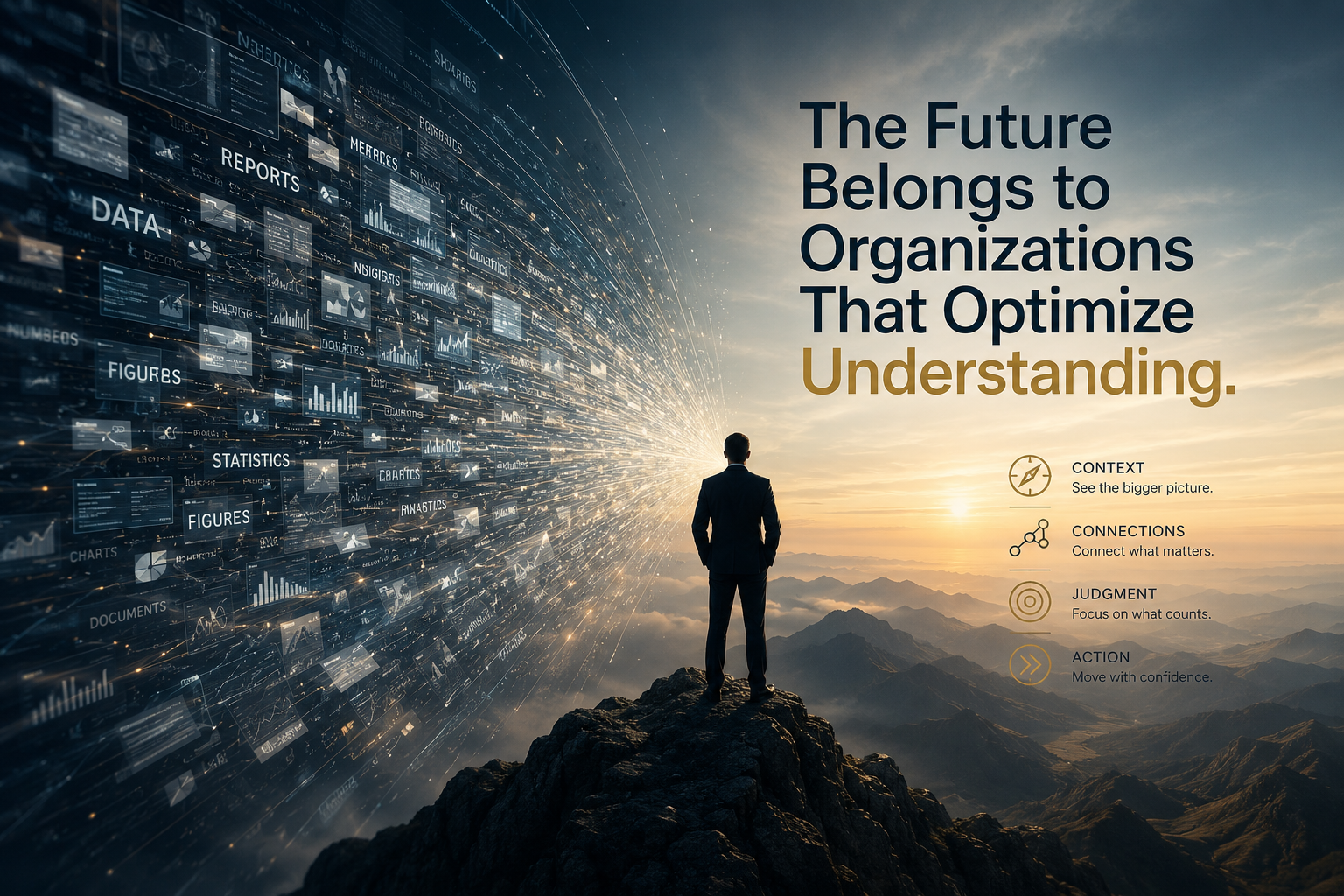
For most of modern economic history, organizations competed by optimizing tangible resources. Land, capital, manufacturing capacity, logistics, distribution networks, and eventually digital infrastructure defined competitive strength. As technology accelerated, information itself became the strategic asset. The companies capable of collecting more data, processing larger volumes of transactions, and building sophisticated reporting systems gained measurable advantages over slower competitors. Entire industries invested billions into data warehouses, business intelligence platforms, enterprise resource planning systems, and increasingly complex analytics environments. Information became the new oil because it could be refined into operational efficiency.
Artificial intelligence quietly changes that equation.
While Information is now abundant, inexpensive, and increasingly automatically generated and every organization has access to models capable of summarizing documents, producing reports, writing software, translating languages, analyzing financial statements, and generating strategic presentations within seconds, the technical barriers that once protected informational advantages are now obsolete. What remains scarce is not access to information, but the organizational ability to understand what actually matters and ahow to align it.
This distinction appears subtle, yet it fundamentally changes the architecture of competition.
Organizations that continue measuring their maturity through dashboards, KPIs, and reporting volume may discover that they have optimized visibility without improving judgment. Executives are surrounded by more indicators than at any point in history, while simultaneously operating in environments that have become less predictable. The contradictions are cognitive and although people have experienced the freedom of thought, they were not trained to deal with ambiguity and contradictory data in uncertainty..
Better instruments do not automatically produce better orientation.
Understanding emerges only when information acquires context, relationships, priorities, constraints, historical memory, and strategic consequence. Facts are not definitory for taking decissions. Those are produced by constructing meaning.
This becomes increasingly visible during moments of systemic pressure.
During global supply chain disruptions, thousands of companies had access to identical shipping reports, identical port congestion maps, identical commodity prices, and identical geopolitical news. Yet their outcomes differed dramatically. Some organizations interpreted the disturbance as a temporary logistics problem. Others recognized that global production architecture itself was beginning to reorganize.
The first group negotiated freight contracts, the second redesigned supplier ecosystems, diversified manufacturing locations, invested in regional resilience, and fundamentally changed procurement philosophy.
Both possessed the same information, but only one possessed deeper organizational understanding.
Years later, the strategic consequences became obvious. The competitive advantage never came from knowing that containers were delayed. It came from understanding what those delays revealed about the future structure of globalization.
The semiconductor industry provides another example.
When chip shortages emerged, public discussion centered on manufacturing delays. Organizations with stronger strategic understanding recognized something larger unfolding beneath the headlines. Semiconductors transformed from simply industrial components to instruments of national security, technological sovereignty, military capability, artificial intelligence infrastructure, and geopolitical leverage.
The organizations that understood this shift expanded investments, diversified partnerships, secured long-term manufacturing agreements, and treated semiconductor capacity as strategic infrastructure rather than procurement inventory.
The shortage eventually eased, but the strategic transformation never reversed.
Understanding allowed organizations to see permanence inside temporary events.
Financial markets demonstrate the same principle repeatedly. Every investor receives the same quarterly earnings report. The report itself creates almost no competitive advantage. Understanding develops from interpreting what those numbers indicate about management quality, capital allocation discipline, customer behavior, technological disruption, regulatory pressure, competitive positioning, and long-term strategic optionality.
Two analysts may read identical balance sheets while reaching fundamentally different conclusions because one reads numbers while the other reads organizational dynamics.
That level of nderstanding transforms static information into future probabilities.
Many executives initially assume AI primarily automates knowledge work. But in reality, AI commoditizes information production. Reports become easier to write, analysis becomes faster and research is accessible to almost everyone.
Ironically, this abundance increases the strategic value of human understanding rather than reducing it.
When every competitor can generate a market analysis within thirty seconds, competitive differentiation comes from recognizing which report actually matters. The compass becomes harder to read for the unprepared.
As generative systems continue lowering the cost of producing information, organizations face an unexpected paradox. The easier knowledge becomes to generate, the harder understanding becomes to maintain and to keep the orientation. Because understanding and alignment of that understanding is the mechanism that allocates attention and resources correctly.
This transformation changes the role of leadership itself, because executives have traditionally been rewarded for possessing answers. Leadership shifts from information authority toward orientation authority and the objective is no longer to know everything, but to enable the organization to perceive reality coherently despite overwhelming informational noise.
Future executives will increasingly be rewarded for constructing shared understanding across increasingly complex organizations.
This explains why some organizations remain remarkably adaptive despite operating in volatile environments. They optimize understanding rather than reporting, the assumptions are shared, making cooperation between stakeholders and teams to be both dynamically aligned, or otherwise put, always synchronized, like everyone knows how to dance on the music they hear.
This requires organizations to rethink how they design themselves. Because business intelligence systems traditionally answer what happened, while the emerging question becomes why it happened and what are the probable outcomes
Cultural intelligence explains how different actors interpret the same event. Strategic intelligence explores what consequences emerge next. Artificial intelligence accelerates each layer while simultaneously demanding stronger human judgment to integrate them.
Organizations therefore begin evolving from information-processing systems into understanding-producing systems and multiple reality domains. This distinction may become the defining management transition of the AI era.
The organizations leading the next decade are unlikely to be those owning the largest datasets, nor necessarily those deploying the largest language models. Nor even those automating the highest percentage of administrative work.
They will be the organizations capable of transforming continuous streams of information into coherent, shared understanding that improves judgment at every level of decision-making. Because understanding compounds and each well-understood decision improves the next one.
The new automated cycle means that shared understanding strengthens trust, trust accelerates execution, execution generates learning and learning deepens understanding again. Unlike information, understanding creates a self-reinforcing organizational capability that competitors cannot easily replicate through software licenses or technology investments alone.
Artificial intelligence will undoubtedly become one of the most powerful organizational tools ever developed. Yet its greatest contribution may not be the information it generates. Its greatest contribution may be forcing organizations to rediscover that understanding, not information, has always been the true source of strategic advantage.
The future, therefore, belongs to organizations that optimize understanding, because understanding is no longer merely a cognitive asset. It is becoming the architecture through which modern organizations perceive reality, coordinate action, and create enduring competitive advantage.