
The Infrastructure of Legacy
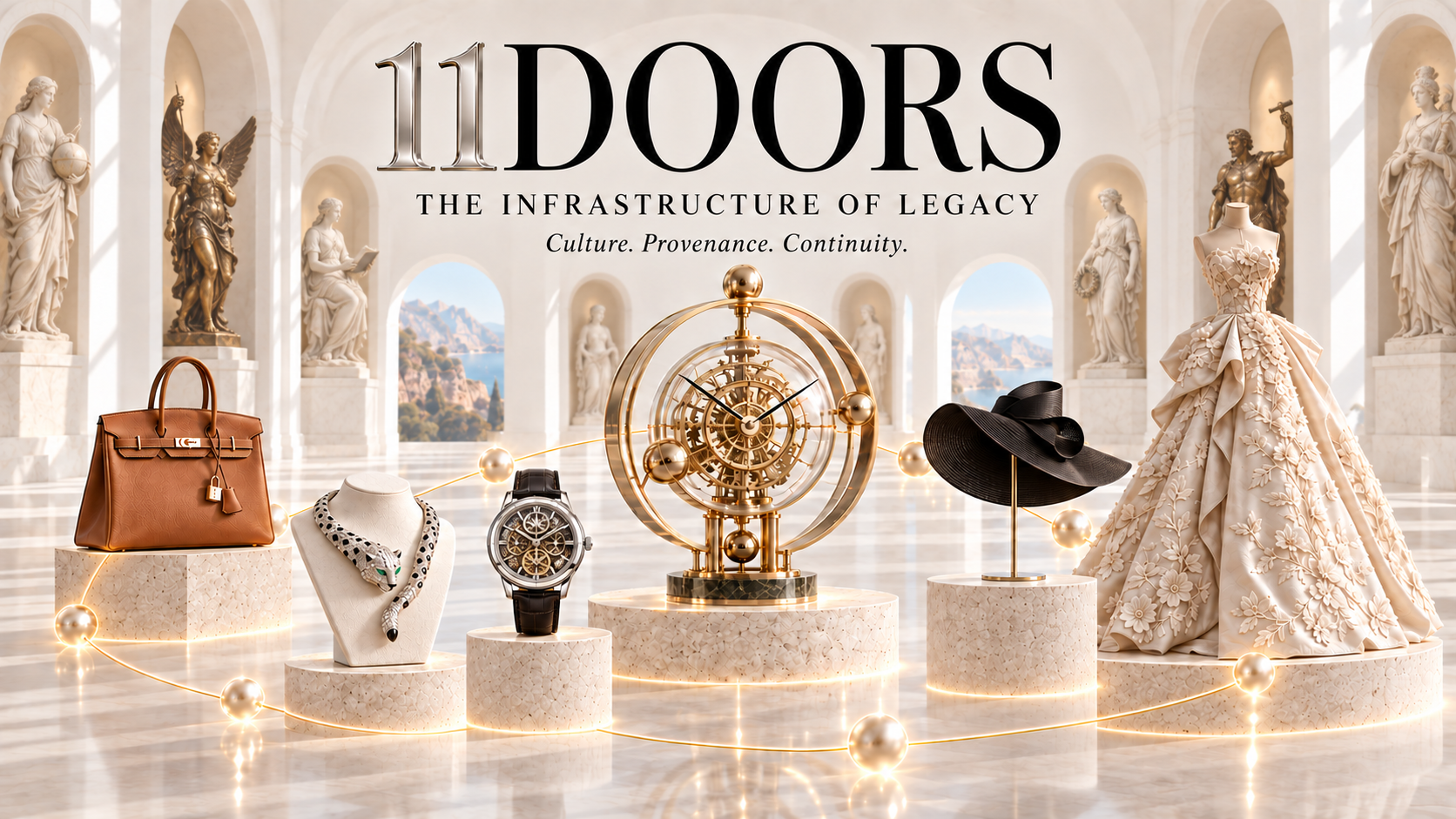
How luxury converts culture into economic architecture
Luxury has always understood something that the wider economy periodically forgets: value survives when it is protected by culture, reinforced through institutions and carried forward by an infrastructure capable of preserving meaning across generations, because craftsmanship alone, however exceptional, cannot secure its own continuity when markets become faster, supply chains become harder to read, imitation becomes effortless and consumers lose the ability to distinguish an inherited standard from a convincing performance of one.
The creation of the Aura Blockchain Consortium by LVMH, Prada Group and Cartier therefore deserves to be examined beyond the fashionable language of blockchain, digital twins and product passports, since its strategic importance lies in the decision of some of the world’s most powerful luxury houses to build a shared architecture for provenance, authenticity and continuity. Aura allows a physical product to acquire a verifiable digital identity through which its origin, materials, manufacturing history, ownership, care, repair and eventual resale may be recorded, creating a durable line between the object presented to the customer and the economic, cultural and human history from which its value emerged. The consortium describes this infrastructure as a means of giving consumers access to trusted product histories and proof of authenticity throughout the product lifecycle, while its membership model brings competing luxury houses into a common framework for traceability and digital product standards. Prada Group’s founding announcement Aura Blockchain Consortium
This is legacy management conducted through infrastructure.
For centuries, luxury houses secured continuity through archives, ateliers, family histories, protected techniques, trusted suppliers, apprenticeship and the slow accumulation of reputation, yet the contemporary market requires these intangible assets to travel through digital environments in which a beautiful story can be generated instantly, an image can be reproduced almost perfectly and an assertion of authenticity can circulate faster than the evidence supporting it. Under such conditions, heritage needs an architecture capable of carrying proof, because the cultural authority of a house eventually becomes vulnerable when its history remains locked inside internal archives while its products circulate through global markets, resale platforms, repair networks and digital spaces largely detached from the place and discipline of their creation.
A digital passport gives legacy operational form. It allows the life of an object to remain connected to the house that created it, the materials from which it was made, the people and techniques involved in its production, the instructions necessary for its preservation and the chain of ownership through which it continues to accumulate meaning. For the customer, this creates confidence; for the brand, it protects reputation and intellectual capital; for the market, it establishes a more credible language of value; and for the object itself, it provides the informational continuity required to move from purchase to care, repair, resale and, where possible, recovery of materials.
The strategic achievement of Aura also comes from cooperation among competitors who understand that a market cannot preserve value when each participant must construct the foundations of trust alone. LVMH, Prada and Cartier compete intensely for attention, talent, suppliers, cultural relevance and customer loyalty, yet authenticity, traceability and credible product information represent shared economic foundations, much as transport networks, payment systems, commercial law and professional standards support competition without belonging exclusively to any single competitor. By cooperating at the infrastructural level, luxury houses strengthen the environment within which their individual identities can remain distinctive.
This matters because mature industries are built around a combination of private excellence and collective architecture. Individual brands create desire, while institutions preserve the conditions under which desire can become durable economic value. A company may possess magnificent design, remarkable craftsmanship and a persuasive founder, although without standards for provenance, ownership, maintenance and circulation, much of that value remains dependent on reputation alone. Reputation travels through memory and social recognition; infrastructure allows it to travel through systems.
The houses participating in Aura sell primarily to affluent customers, but their cultural reach extends far beyond the wallets capable of buying their products. Luxury occupies a relatively narrow commercial segment while exercising an unusually broad educational influence over materials, colour, form, presentation, retail experience, service, durability and aspiration. A handbag seen on a runway may inspire a local leather studio; the visual language of a Parisian maison may shape the packaging of a small cosmetics company in Bucharest; the restoration policy of a watchmaker may teach an independent designer that longevity can become part of the product proposition; and a digital passport developed for a high-value object may eventually help a small furniture workshop explain where its wood came from, who made the piece, how it should be repaired and why it deserves to remain in use.
This is how cultural leadership enters the mainstream: gradually, through imitation, interpretation, education and the diffusion of standards.
Small business owners rarely copy the full operating model of a luxury conglomerate, nor would such an attempt make economic sense, but they absorb signals about what markets are learning to value. When leading houses invest in traceability, repairability, provenance and lifecycle information, they teach a much larger commercial ecosystem that the sale no longer represents the final meaningful interaction between producer and product. Designers begin to consider how an object ages; retailers learn to communicate care and origin; customers learn to ask questions about materials and production; resale platforms seek stronger authentication; repair becomes part of the customer relationship; and business owners discover that continuity can generate revenue, loyalty and cultural credibility long after the first transaction has been completed.
This constitutes an education in circular economics delivered through objects people already desire.
The circular economy is often communicated through sacrifice, restriction and administrative obligation, a vocabulary that may satisfy policy frameworks while failing to create emotional participation. Luxury possesses a different cultural instrument: it can make longevity desirable. A beautifully constructed object that can be authenticated, maintained, repaired, inherited and resold gives the circular economy a visible and emotionally persuasive form, because preservation becomes associated with discernment, care and retained value. The product remains inside the economy for longer, while knowledge about its materials and history allows future owners, repairers and merchants to make better decisions about its use.
Aura’s deeper significance therefore resides in the connection it creates between technological infrastructure and cultural memory. Blockchain contributes a record designed to resist casual alteration; the product passport organizes information around the object; the brand supplies the standards and primary data; and the customer encounters a coherent history that can continue across ownership and time. Each component reinforces the others, turning provenance from a marketing paragraph into a governed information system.
The quality of that system will always depend on the quality of the data entered into it, because technology can preserve a record without independently guaranteeing that every original claim was accurate. Governance, supplier verification, audit procedures and institutional accountability remain essential. This limitation strengthens the strategic argument rather than weakening it: trust cannot be outsourced to software, and serious infrastructure requires a combination of technology, standards, human responsibility and credible institutions. Aura becomes valuable through the discipline surrounding the ledger, the willingness of brands to establish common rules and the reputational consequences attached to the information they provide.
There is also a larger economic lesson here. Europe frequently discusses competitiveness through production volumes, regulation, investment and technological capacity, while its most durable advantage may reside in the ability to connect culture, industrial knowledge and institutional trust. Luxury houses preserve specialised crafts, regional supply networks, design intelligence, archives and forms of material knowledge that cannot be recreated instantly through capital expenditure. When these assets are connected to modern infrastructure, heritage becomes economically mobile without losing its origin, allowing tradition to function as productive capital inside contemporary markets.
For smaller companies, the lesson begins with strategic orientation rather than technological imitation. A florist, furniture maker, ceramic studio, fashion designer or independent beauty brand may have no immediate need for a proprietary blockchain, but each can begin creating the informational discipline from which trustworthy product identities emerge: documenting origin, naming materials, preserving design records, explaining care, maintaining relationships with producers, offering repair where possible and treating every product as part of a lifecycle rather than a momentary transaction. These practices build the cultural and operational foundations upon which future traceability systems can be added.
The decisive question for any brand then becomes: what will remain attached to the product after it leaves the shop?
If the answer includes knowledge, proof, service, memory and a path toward repair or recirculation, the company has started building legacy. If the relationship ends with the receipt, much of the value painstakingly created during design and production becomes vulnerable to disappearance, imitation or irrelevance.
Luxury’s role within the wider economy has never depended solely on the number of people who can afford its products. Its broader influence comes from its capacity to establish standards of excellence that travel downward, sideways and outward through markets, inspiring independent designers, shaping consumer expectations and demonstrating what long-term value can look like when culture and commerce reinforce one another. The niche wallet buys the object; the mainstream market absorbs the language, the discipline and eventually the infrastructure surrounding it.
Aura represents one of those moments in which an industry begins constructing the future conditions of its own credibility. The blockchain may remain invisible to most customers, as good infrastructure often does, while the confidence it supports becomes visible through authenticated objects, transparent histories, stronger resale markets, informed maintenance and products capable of carrying their identity through time.
Legacy survives through memory, although memory becomes economically powerful when institutions know how to protect it. Culture creates the meaning, infrastructure carries it forward, and leadership begins when the strongest participants in a market build foundations sturdy enough for others to learn from, adapt and eventually use.