The Three Authorities That Shape Civilizations
Most people are taught to read power through elections, presidents, parliaments, and wars. This is only the visible layer. Beneath headlines and ceremonies, societies are usually shaped by three older and more enduring forms of authority: civic authority, trade authority, and sacred authority. Whoever understands their relationship understands far more than daily politics.
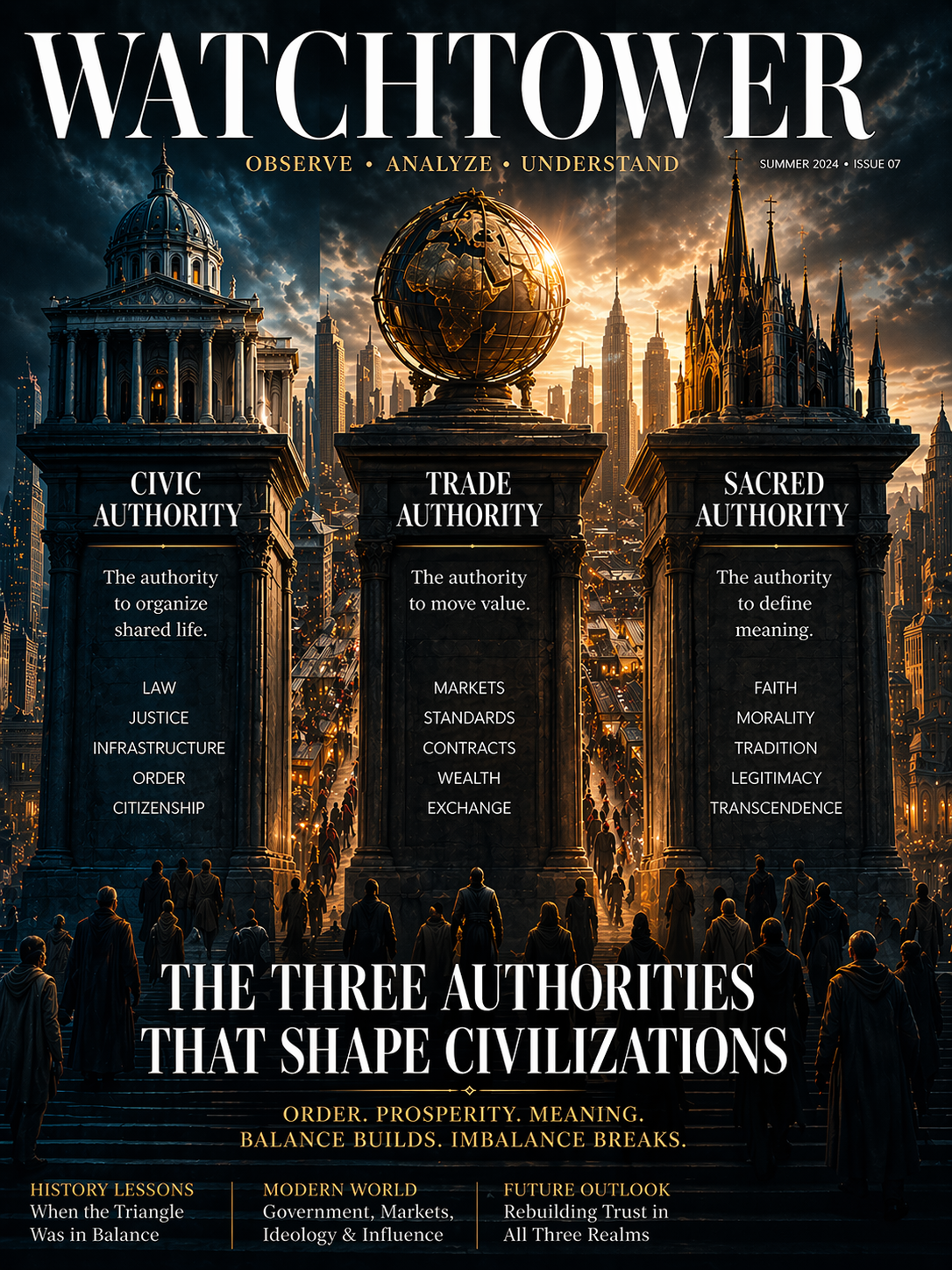
Civic authority governs common life. It builds roads, writes regulations, settles disputes, defines citizenship, collects taxes, and maintains order. It is the authority of the city, the ministry, the court, the state. Its greatest gift is predictability. When civic authority functions well, people can plan their lives because rules exist beyond moods and personal whims. When it decays, daily life becomes expensive in invisible ways: delays, uncertainty, corruption, exhaustion, cynicism.
Trade authority governs movement of value. It determines how goods travel, how contracts are trusted, how capital is allocated, which ports rise, which currencies hold, which industries scale, and which supply chains survive pressure. It is the authority of merchants, financiers, guilds, corporations, logistics networks, markets, and increasingly digital platforms. Its greatest gift is prosperity through flow. When healthy, trade authority multiplies opportunity. When distorted, it converts society into extraction, where citizens feel less like participants and more like rented assets.
Sacred authority governs meaning. It decides what is honorable, shameful, holy, forbidden, legitimate, redeemable, worth sacrifice, worth mourning, worth preserving. In older ages this authority belonged openly to temples, churches, monasteries, priesthoods, dynastic rites. In modern societies it often migrates into schools, media systems, entertainment, ideology, prestige institutions, and the moral language of the age. Its greatest gift is orientation. People can survive hardship if life still means something. Without sacred authority, societies often become materially functional but spiritually vacant.
Civilizations become resilient when these three authorities remain distinct yet cooperative. Civic authority should administer fairly, not pretend to be a religion. Trade authority should generate wealth, not purchase sovereignty. Sacred authority should guide conscience, not run procurement systems. Once boundaries collapse, dysfunction begins.
A state captured by trade authority becomes managerial oligarchy. Laws increasingly resemble service agreements for the powerful. Citizens sense that public language speaks of values while real decisions follow capital concentration, dependency, and access. The institutions remain, but the hierarchy changes.
A state captured by sacred authority becomes moral absolutism. Complex realities are flattened into purity tests. Competence declines because symbolism outranks administration. The result is often righteous disorder, where many speak in the name of truth while roads, budgets, and systems quietly fail.
A sacred sphere captured by trade authority becomes commercialization of meaning. Identity turns into product, outrage into subscription model, belonging into merchandise, ritual into monetized experience. People feel stimulated but not nourished.
A civic sphere without sacred ballast becomes sterile bureaucracy. Everything is processed, little is understood. The forms survive while trust evaporates.
Many historical powers understood this intuitively. Durable states often balanced magistrates, merchants, and priests in varying proportions. The names changed across eras, but the structure remained. Governance required law, surplus required commerce, legitimacy required meaning.
The contemporary world did not abolish this triangle. Some digitized it, some are still struggling with what contemporary means. Civic authority now competes with transnational systems and administrative networks. Trade authority operates at algorithmic speed through finance, logistics, and platforms. Sacred authority increasingly flows through narratives, feeds, status signals, and attention economies. Meaning has not disappeared. It has been outsourced, fragmented, and industrialized.
This explains why many citizens feel confused even when formal institutions remain intact. They are trying to live under one constitution while being governed psychologically by another. They vote in one arena, earn in another, and derive meaning in a third. The fragmentation creates fatigue.
For emerging societies, including those seeking stronger sovereignty, the lesson is straightforward. Political reform alone is insufficient. Economic policy alone is insufficient. Cultural rhetoric alone is insufficient. A serious national project must align civic competence, productive trade systems, and a credible moral narrative. Without all three, momentum stalls.
Watchtower thinking begins by asking a harder question than “Who is in office?” It asks: who governs daily life, who governs value, and who governs meaning? Titles matter less once those answers are clear.
Every age claims to be modern. Most are simply old struggles wearing new clothes.