
Pinocchio wears Prada. The Economy of Becoming Real
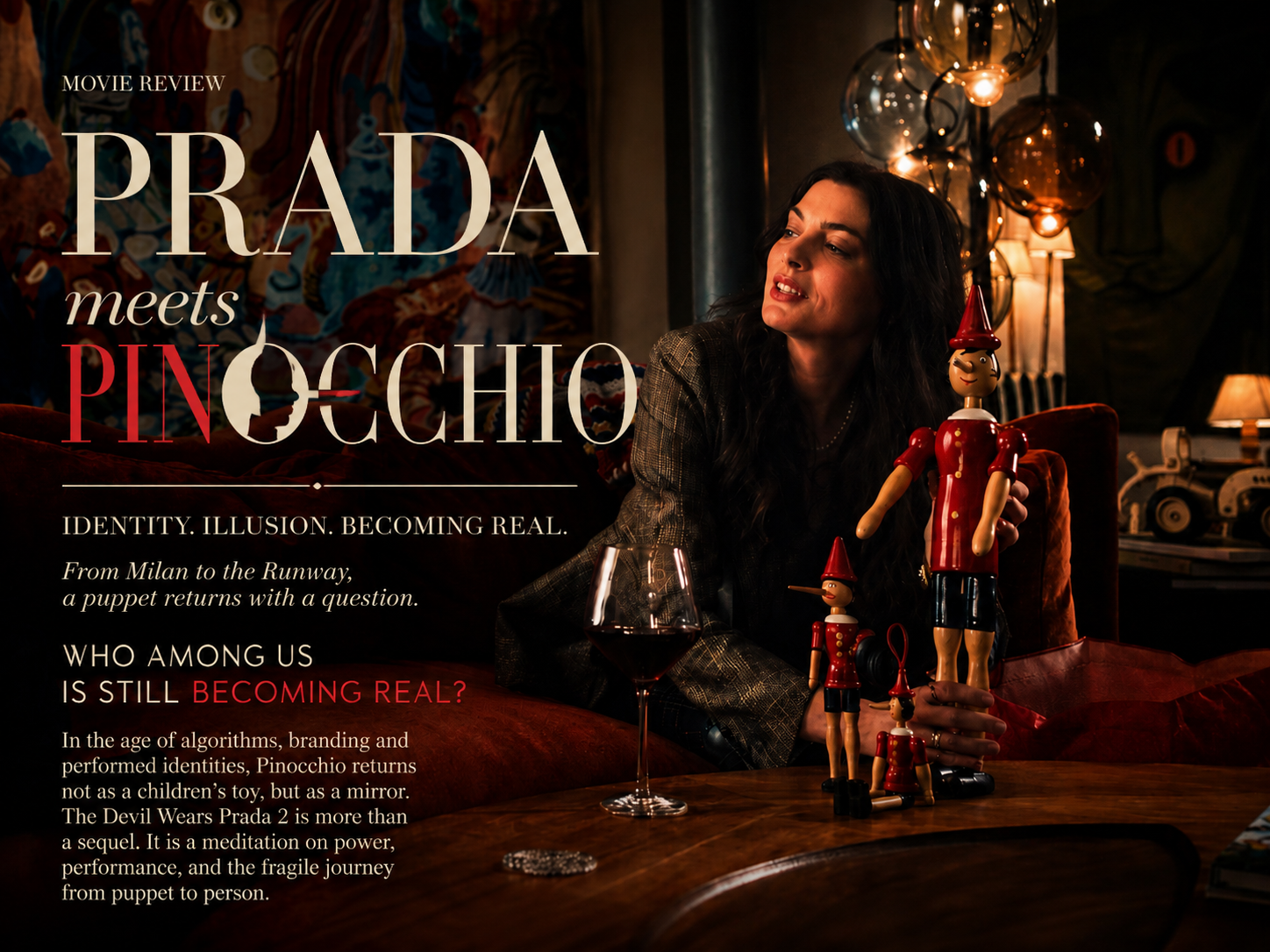
On imitation, performace and the industry of becoming real – A deeper lens review on The Devil wear Prada 2
What makes The Devil Wears Prada 2 a surprisingly powerful cinematic construction is its symbolic continuity across culture, architecture, and behavioral patterns, not as random trivia, but as recurring structures of meaning. Beyond fashion, beyond branding, the film quietly moves toward a larger question: identity. The identity people build, and the identity people borrow.
Which is why the most interesting angle for this review is not the obvious conflict between fashion and corporate culture, nor even the plot itself, but the symbolic language hidden inside the composition.
Through carefully selected objects, photographic framing, color, and narrative signaling, the film invites the viewer to read beyond the dialogue. And in one of its most subtle gestures, it places a seemingly innocent object at the center of the final composition: Pinocchio.
Yes, Pinocchio, dressed in red.
In visual storytelling traditions, red is rarely accidental. Across symbolic systems, the color is associated with initiation, transformation, temptation, vitality, individuation, and the crossing from innocence into consciousness. Beyond Miranda’s red dress or her red shoes, the Pinocchio figure becomes a deliberate visual echo: the childish puppet suspended between performance and the painful process of becoming “real.”
And Pinocchio remains one of the oldest surviving modern myths precisely because he is not merely a moral tale about lying. He is a character trying to acquire conscience, embodiment, and responsibility while constantly being pulled toward spectacle, shortcuts, theater, pleasure, and manipulation.
All themes already embedded in the original The Devil Wears Prada.
The Pinocchio toy fits naturally into the larger architecture of the sequel because it extends the deeper tension already present in the Prada universe: who is becoming real, and who is becoming manufactured?
Its origin matters too. The toy is brought from Milan, one of the great capitals of crafted identity, tailoring, illusion, refinement, and performed elegance. Milan historically understood something that modern optimization culture often forgets: style was never meant to erase humanity. It was meant to refine it.
That stands in direct contrast with contemporary systems that increasingly reward polished puppetry over authentic presence.
And this is where the film becomes more interesting than its surface suggests.
Andy returns transformed and legible to power, yet without fully surrendering her inner authenticity. Miranda, meanwhile, continues to embody absolute composure even in moments of fracture. Fashion itself operates less as vanity and more as a coded language of hierarchy, discipline, performance, and access.
But the introduction of Pinocchio quietly changes the lens through which the entire story can be read.
Because in the age of algorithms, branding, performed identities, and manufactured personas, Pinocchio returns from Milan not as a children’s toy, but as a cultural question:
Who among us is still becoming real?
And perhaps this is why the Prada universe continues to survive culturally while so many modern corporate narratives collapse into sterile efficiency. The film understands that human beings do not live by optimization alone. They live through ritual, aspiration, symbols, performance, discipline, and the endless negotiation between authenticity and social construction. Fashion, in this universe, is never just clothing. It is architecture for identity.
And Pinocchio, the puppet trying to become human, may be the most honest symbol the film could have placed on the table.