
Augmented Reality – The Original Spatial Computing
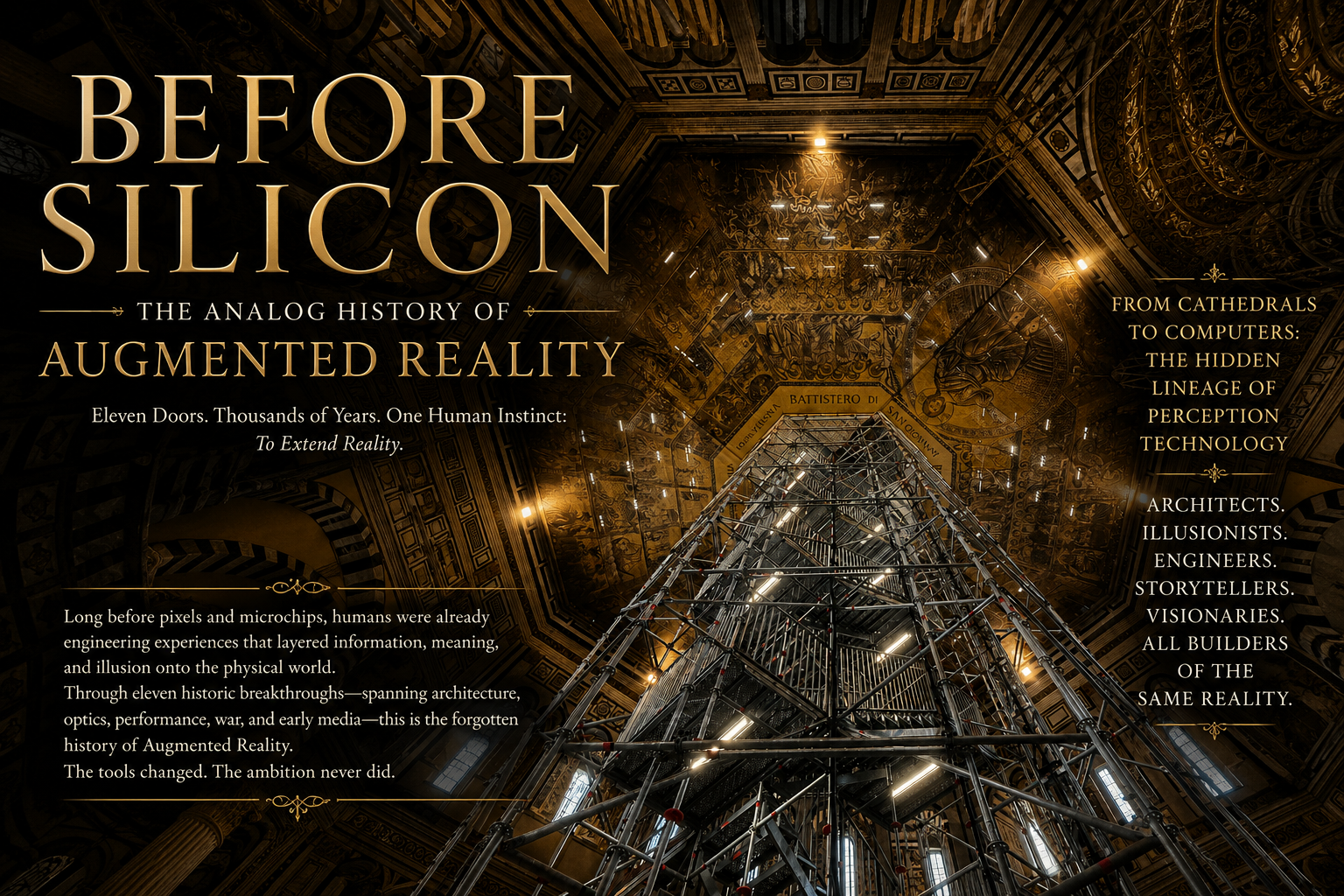
Long before we had pixels, microchips, and transparent OLED screens, humans were absolutely obsessed with the core promise of Augmented Reality (AR): layering a fabricated illusion directly over the physical world to alter our perception of reality.
If we strip away the digital tech, “analog AR” was accomplished using pure physics : mirrors, glass, architecture, and the quirks of human biology.
Here is how our ancestors hacked reality using purely analog means : by architectural means..
During the Renaissance, artists realized they could use precise linear perspective to trick the human brain into seeing 3D depth on flat, 2D surfaces. They called it trompe l’œil – literally “deceive the eye.”
Instead of looking at a normal ceiling, people would look up and see a massive, soaring dome filled with angels that didn’t actually exist. It was architectural augmentation; it took the physical limits of a room and expanded them mathematically.
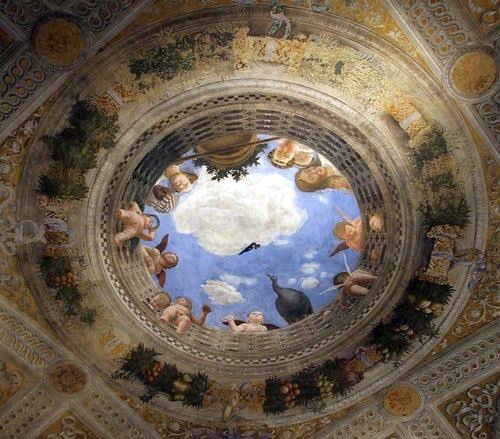
Before people could create digital overlays, they had to figure out how to trick the brain into seeing depth where there was none. This all exploded during the Italian Renaissance with the discovery of linear perspective to give the illusion of the infinite.
Imagine walking into a church in the 1400s or 1500s. The physical walls are flat, solid, and oppressive. But then you look up at the ceiling, and the stone entirely disappears. Instead, you see a massive dome stretching up into the clouds, or a staircase leading straight into the sky. Or even fake doors that lead to nowhere but straight and solid walls.
How the “Analog Code” Worked
To make this augmentation work without a computer rendering engine, the artist had to act like a modern software engineer, calculating angles based on exactly where a human viewer would be standing.
They used three main rules to hack human visual processing:
- The Vanishing Point: Every single painted line in the room had to converge toward a single imaginary dot. If you stood exactly where the artist intended, your brain would automatically interpret those lines as moving away from you in 3D space.
- Anamorphosis (Perspective Distortion): If you looked at these paintings from the side, they looked incredibly stretched, warped, and bizarre. But from the center of the room, the distortion flattened out, perfectly overlaying a fake 3D structure onto the physical room.
- Atmospheric Perspective: They noticed that the human eye sees distant objects as lighter and bluer because of the air in between. By painting the “higher” parts of a fake dome with less contrast and cooler tones, they simulated miles of depth on a surface only inches thick.
The Original “Sweet Spot”: Just like modern AR glasses require you to calibrate them to your eyes, Renaissance quadratura required the viewer to stand on a specific tile on the floor. Step off that tile, and the digital-like illusion completely shattered.
So the concept of Augmented Reality did not begin with the silicon chip, computer code, or transparent digital screens. Long before the word “digital” entered our lexicon, humans harbored an intense desire to layer a fabricated, alternative reality directly over the physical world. This analog era of spatial computing was powered not by algorithms, but by the strict laws of physics, mathematics, optics, and an intimate understanding of human visual psychology.
By exploring eleven distinct historical “doors”, milestones of analog augmentation, we reveal that the urge to expand our perception of reality is a fundamental human instinct, one that found its earliest expressions through pure craftsmanship, optical architecture, and the tools that have adapted over time.
Door 1: Linear Perspective and Quadratura (The 15th Century)
The foundation of spatial mapping was laid during the Italian Renaissance with the mastery of linear perspective. Artists like Andrea Mantegna and later Baroque masters engineered a technique called quadratura—painting false architectural extensions onto flat walls and ceilings. By establishing a rigid, mathematical “vanishing point,” they forced flat stone surfaces to completely dissolve. To a viewer standing on a specific tile on the floor (the original calibration process), a flat ceiling suddenly opened into a soaring, three-dimensional dome filled with sky and floating figures. It was the birth of architectural AR: using math to break the physical boundaries of a room.
Door 2: Magic Lantern Phantasmagoria (The Late 18th Century)
In the dark, tense years surrounding the French Revolution, showmen like Étienne-Gaspard Robert (Robertson) created Phantasmagoria, the earliest mobile projection AR. Instead of projecting onto solid, obvious walls, Robertson hid his massive optical lanterns (called the Megascope) behind curtains and projected terrifying images of ghosts and demons onto semi-transparent screens of smoke, gauze, or black velvet. Because the audience was held in pitch darkness and could not see the projection medium, the spirits appeared to float independently in the middle of the room, occupying the exact same physical space as the terrified viewers. The theater described how to scare people with projected images. A techique later used by many charlatans who claimed powers they never had.
Door 3: The Camera Lucida (1806)
Invented by Sir William Hyde Wollaston, the Camera Lucida was the first true wearable, optical “heads-up display” for artists. It utilized a precisely angled prism suspended on a small metal rod over an artist’s drawing paper. When the artist looked down through the edge of the prism, their eye performed an ingenious optical split: they saw the real-world landscape ahead of them reflected through the glass, layered seamlessly over their physical hand and drawing pad below. It allowed artists to trace reality with absolute mathematical precision, superimposing a virtual reference layer directly onto their physical canvas.
Door 4: Sir Charles Wheatstone’s Stereoscope (1838)
Before Virtual Reality headsets, the Victorian era obsessed over the Stereoscope. Sir Charles Wheatstone discovered that the human brain constructs 3D depth by combining two slightly different 2D images captured by our left and right eyes (binocular vision). By mounting two offset photographs side-by-side in a wooden viewer with twin lenses, the Stereoscope forced the brain to merge them into a single image with shocking depth. Victorians quickly used this to augment historical and fantasy narratives, inserting drawn “ghosts” or miniature historical figures into real photographic landscapes, making impossible illusions pop into true three-dimensional space.
Door 5: Pepper’s Ghost (1862)
The absolute crown jewel of Victorian analog AR and the technology later perfected by Disney for the Haunted Mansion’s ballroom, was popularized by John Henry Pepper. This illusion relied on a massive sheet of pristine plate glass placed across a theatrical stage at a precise 45-degree angle. The glass was entirely invisible to the audience, allowing them to look straight through to the real actors. However, by using high-intensity limelight lanterns to illuminate a hidden actor standing in a pitch-black pit beneath the stage, that actor’s reflection would suddenly materialize onto the glass. The result was a transparent, three-dimensional entity seamlessly interacting with physical actors in real time.
Door 6: The Panorama and Cyclorama Buildings (The 19th Century)
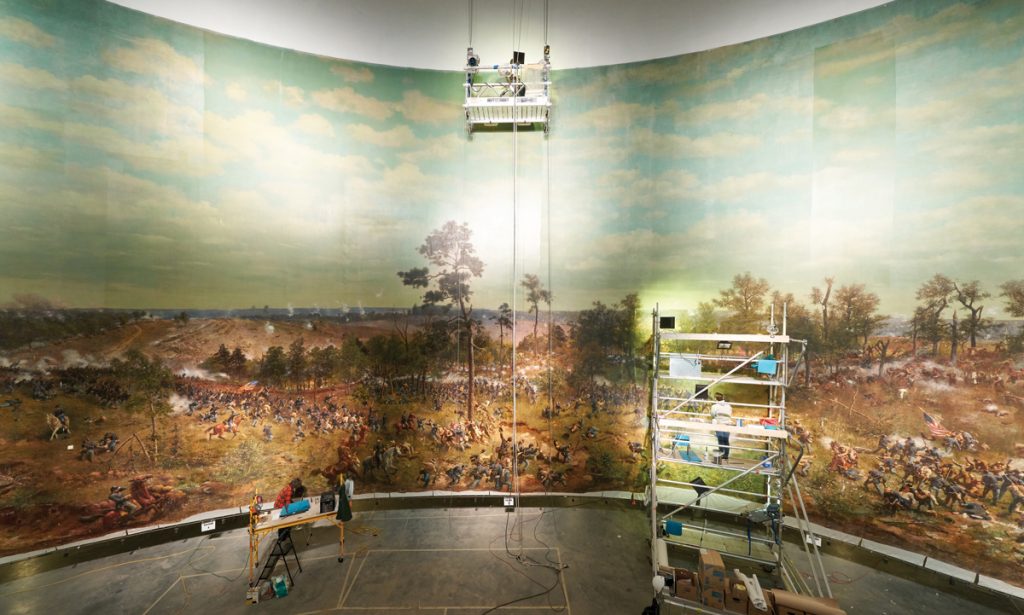
Before panoramic photo modes on smartphones, 19th-century citizens stepped into massive, purpose-built circular buildings to experience total geographic augmentation. Artists painted breathtaking, 360-degree landscapes (often depicting famous battles or grand vistas like the Swiss Alps) on the interior walls. To blur the line between the painting and reality, the center of the room featured a physical platform surrounded by “faux terrains”, real dirt, rocks, broken wagons, and physical bushes that bled seamlessly into the painted background. It was a massive, physical spatial environment where the real and the fabricated became indistinguishable.
Cycloramas were invented by Robert Barker (1739-1806) an irish portraitt painter.
Door 7: The “Joyous Paintbrush” of Early Animation Studios (The 1920s–1940s)
While earlier forms of analog AR focused on deceiving the eye, animation attempted something far more ambitious: engineering motion itself. The great animation studios of the twentieth century discovered that movement could be reduced to principles, measured, repeated, and improved. Squash and Stretch, Anticipation, Timing, and Follow Through were not merely artistic techniques; they were models of how living systems appear to behave. Long before computer simulation, animators were building physics engines with paintbrushes. The modern digital world, from video games to AI avatars, still rests on foundations first established by artists working frame by frame under studio lamps. They bypassed the cold limits or both art and physical world to prioritize emotional truth, rhythm, and life over strict realism.
Door 8: Optical Compositing in the Cinema Age(1944)
Closer to our time and still long before digital green-screens and CGI, Walt Disney’s studio achieved a monumental feat of analog AR. To make characters animate seamlessly alongside real-world, live-action actors, animators had to use physical compositing. They projected live-action film frame-by-frame onto animation desks (rotoscoping) so artists could map eye-lines and physical boundaries. The cartoon characters were then painted onto transparent celluloid sheets (cells) and physically layered on top of the real film prints using a specialized Multiplane camera rig. It was a literal, physical overlay of a vibrant fantasy universe directly on top of photographic reality.
Door 9: Photographic Camouflage and Optical Deception (World War II)
All of the techniques learned by the engineers in visual arts, were used during the global conflicts of the mid-20th century, where analog AR was weaponized for survival. Military engineers and artists collaborated to augment the appearance of entire landscape infrastructures to deceive enemy bombers. Using giant nets, painted canvas, dummy wood structures, and calculated perspective angles, they turned critical military factories into harmless-looking suburbs or empty fields from the sky. Conversely, dummy tanks and inflatable divisions were deployed to alter the perceived troop counts. It was spatial computing used as a tactical shield, rewriting geographical data using physical materials.
In time, the whole development and scientific study of augmented reality transformed in a way to project information on top of reality. The millitary approach is to take real data, overlay synthetic information and act on the combined view.
During the WW2, the radar operators began translating invisible information into visual displays that guided pilots and anti-aircraft crews. Not exactly AR in the strict sense, but it was the beginning of merging unseen data with physical reality. The principle was “Show the operator more than the eye alone can see” . Which is one of the core ideas in the AR philosophy.
Door 10: Salvador Dalí’s Geometrical Unfolding (1954)
The ultimate intellectual test of analog augmentation came when artists attempted to visualize dimensions beyond human perception, such as the Tesseract (a 4D hypercube). In his masterpiece Corpus Hypercubus, Surrealist master Salvador Dalí rejected sci-fi gimmicks. Instead, he used strict Renaissance perspective and advanced geometry to paint a three-dimensional “unfolded” cross of a four-dimensional tesseract floating in a real space. Dalí used the “joyous” paintbrush to solve a higher-dimensional mathematical puzzle, forcing the human brain to stretch into the fourth dimension using nothing but static oil pigments on a two-dimensional canvas.
While some of the earlier AR techniques augmented physical space, Dalí is one of the great artists to augment cognition itself.
Door 11: Morton Heilig’s Sensorama (1962)
Standing right on the precipice of the computer age, inventor Morton Heilig built the Sensorama, the mechanical peak of pre-digital reality alteration. The Sensorama was a heavy, arcade-style console that didn’t contain a single microchip or digital pixel. Instead, it used intricate bicycle chains, gears, and rollers to play a 3D stereoscopic film of a motorcycle ride through New York City. To fully augment the experience, Heilig rigged the machine with mechanical fans to simulate wind, a vibrating seat to mimic the engine’s rumble, and chemical scent dispensers that released the smell of exhaust and gasoline. It was a fully multisensory reality engine driven entirely by mechanical ingenuity.
The analog history of AR reminds us that the true power of augmenting reality does not lie in the perfection of the machine, but in the humanity of the restriction. Like the French Oulipo writers who found ultimate poetic freedom by imposing rigid mathematical constraints on their literature, the analog creators of AR used the stubbornness of glass, the geometry of perspective, and the limits of the paintbrush to anchor their illusions. In a world increasingly sliding to digital cheap tricks, the act of crafting beauty and joy through intentional, structured artistry remains the ultimate revolution, a sacred effort to calm the audience, conquer the chaos, and restore our sense of wonder.
Intentionally, I left the final bridge between optical architecture, mechanical illusionism, military augmentation and multisensory reality, until the end: the reason Europe was so fascinated with illusion, perspective, and perceptual augmentation. The original AR engine was actually a Cathedral. Not digital or technological, but perceptual.
A medieval cathedral overlaid light, sound, geometry, narrative, and symbolism onto physical space. Through scale, symmetry, acoustics, and visual hierarchy, architecture shaped how people perceived themselves and the world around them. Long before screens and computers, built environments were already teaching perception.
Much of what we call reality is filtered through the structures we inhabit. Schools, churches, public institutions, and cities do more than organize physical space; they influence attention, behavior, and interpretation. When these structures are coherent, they reinforce order and orientation. When they are poorly designed or disconnected from their purpose, they can distort perception just as effectively as they once guided it.